Extension winter-sowing calendars are written as months for one place. Convert those months into days before that place’s median last frost, then add the same offsets to your own ZIP’s NOAA date. Using Washington State University’s Skagit County calendar and Mount Vernon’s median last freeze of March 24, hardy annuals and perennials go out 93 to 24 days before the last frost, tender annuals and vegetables from 23 days before to 37 days after, and tomatoes, peppers and squash 8 to 37 days after.
Why a month-by-month winter sowing calendar does not travel
Three extension pages give the timing as calendar months. WSU Skagit County Extension’s Master Gardener guide (December 2022) starts hardy annuals and perennials from about December 21 through February, tender annuals and vegetables in March and April, and says to wait until April for tomatoes, peppers, eggplant, melons, squash and pumpkins. It is written “for our zones”, meaning Skagit County, Washington. Penn State Extension gives December to March for perennials and hardy annuals and March or April for tender plants. Illinois Extension says to wait until January or February, and to hold frost-sensitive species until March or April.
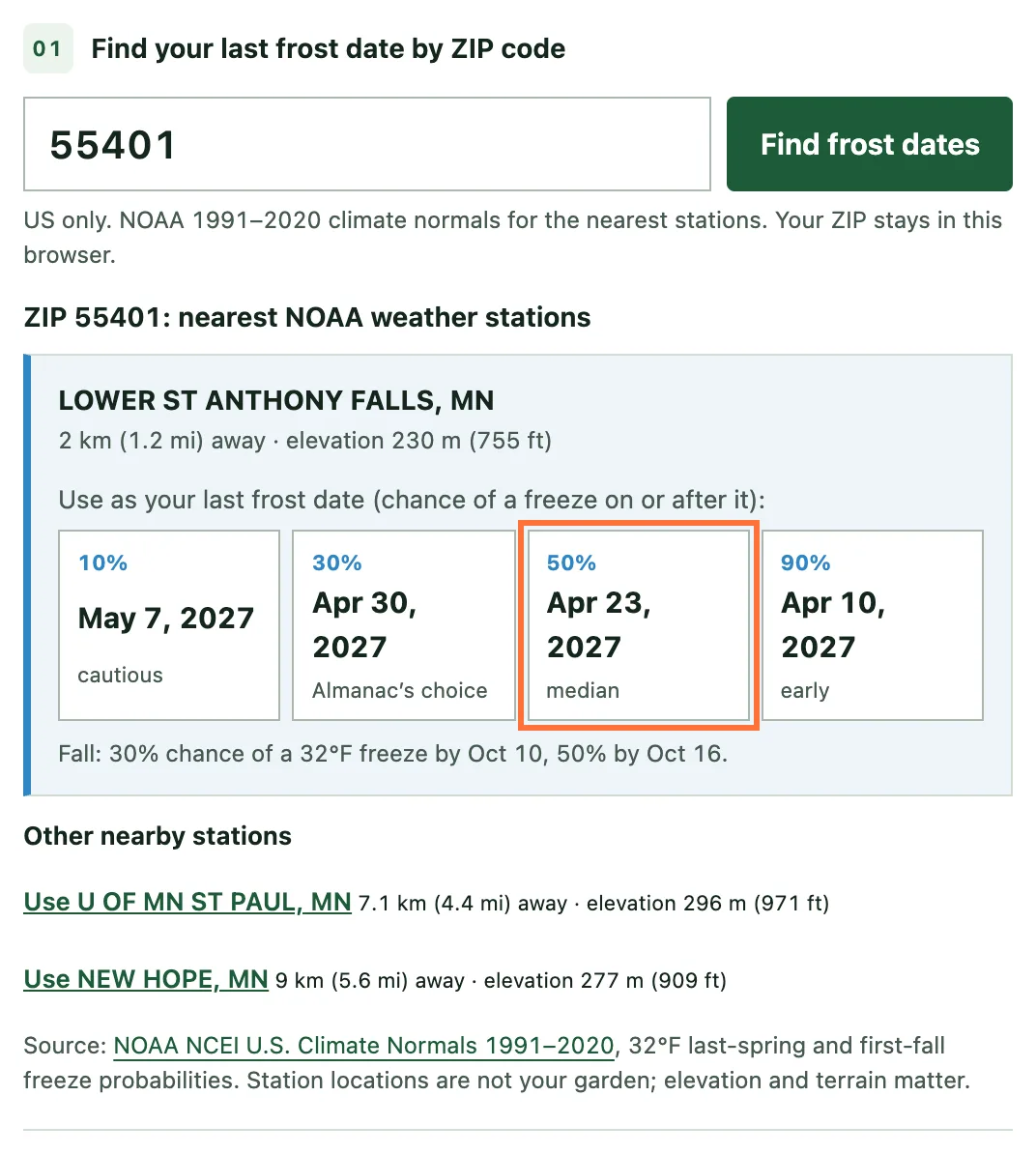
The word “March” does not describe the same point in spring everywhere. In NOAA’s 1991–2020 normals, the median last 32°F freeze is March 24 at the Mount Vernon station near WSU’s Skagit office and April 23 at the Minneapolis station in the screenshot above, 30 days later.
Step 1: turn WSU’s months into frost offsets
We used WSU’s guide as the anchor because it is the only one of the three month calendars written for a single named county. Its nearest NOAA station in Seed Window is MT VERNON 3 WNW, WA, 4.2 km from the Census point for ZIP 98273, with a median (50%) last 32°F freeze of March 24 in the 2027 season. WSU ties only its December 21 start explicitly to Skagit County; its March–April months match Penn State’s, which the WSU guide lists as a resource. The offsets therefore assume that WSU’s months suit Skagit’s frost date. WSU says to wait until April for tomatoes; we treat April 1–30 as that window, so the 37-day end is our assumption.
Your winter-sowing date = your median last frost + offset
| Group (WSU’s wording) | WSU window | Calculation | Offset |
|---|---|---|---|
| Hardy annuals and perennials | December 21 – end of February | Mar 24 − Dec 21 = 93 days; Mar 24 − Feb 28 = 24 days | 93 to 24 days before |
| Tender annuals and vegetables | March – April | Mar 24 − Mar 1 = 23 days; Apr 30 − Mar 24 = 37 days | 23 days before to 37 days after |
| Tomatoes, peppers, eggplant, melons, squash, pumpkins | April | Apr 1 − Mar 24 = 8 days; Apr 30 − Mar 24 = 37 days | 8 to 37 days after |
We used the 50% date because a month calendar describes a typical year, and the median is the typical year in NOAA’s probabilities. If you prefer the 30% date that Seed Window labels “Almanac’s choice”, add the same offsets to that date; every window then moves later by the gap between the two dates.
Step 2: date the calendar for your ZIP
Adding the three offsets to each ZIP’s median gives the table below. The station is the nearest one Seed Window lists for that ZIP; open the link to see its 10%, 30%, 50% and 90% dates.
| ZIP and NOAA station | Median last freeze | Hardy annuals and perennials | Tender annuals and vegetables | Tomatoes, peppers, squash |
|---|---|---|---|---|
| 98273 · MT VERNON 3 WNW, WA (WSU’s reference) | Mar 24 | Dec 21 – Feb 28 | Mar 1 – Apr 30 | Apr 1 – Apr 30 |
| 30303 · ATLANTA FULTON CO AP, GA | Mar 24 | Dec 21 – Feb 28 | Mar 1 – Apr 30 | Apr 1 – Apr 30 |
| 43215 · COLUMBUS WCMH, OH | Apr 20 | Jan 17 – Mar 27 | Mar 28 – May 27 | Apr 28 – May 27 |
| 55401 · LOWER ST ANTHONY FALLS, MN | Apr 23 | Jan 20 – Mar 30 | Mar 31 – May 30 | May 1 – May 30 |
Atlanta’s median falls on the same day as Mount Vernon’s, so WSU’s months carry over unchanged. Columbus and Minneapolis shift about four weeks later. For Minneapolis, the hardy window opens on January 20, not on the solstice.
Step 3: check the translation against a second extension calendar
Illinois Extension’s release is datelined Urbana. The nearest station to ZIP 61801 is CHAMPAIGN 3S, IL, 3.8 km away, with a median last freeze of April 15. Converting Illinois’s own months at that station and comparing them with the WSU offsets gives:
| Seed type | Illinois wording | Illinois months as offsets | WSU offsets dated at Champaign |
|---|---|---|---|
| Start of winter sowing | “January or February” | Jan 1 – Feb 28: 104 to 46 days before | Hardy window starts Jan 12 (93 days before) |
| Frost-sensitive | “March or April” | Mar 1 – Apr 30: 45 days before to 15 days after | Apr 23 – May 22 (8 to 37 days after) |
For hardy seed, the WSU-derived start is consistent with Illinois’s advice to begin in January or February, which Illinois gives for all winter sowing. That window is wide, so this is a consistency check, not a confirmation. For frost-sensitive seed the two disagree: the WSU-derived window starts April 23, 53 days after Illinois’s March 1, and overlaps Illinois’s months only from April 23 to 30. Treat the WSU-derived window as the cautious end of the range, not as the only answer.

Tomatoes and peppers: what the sources say
The sources disagree here. N.C. Cooperative Extension’s Beaufort County guide says to avoid tender plants such as tomatoes and peppers and germinate them indoors. WSU allows them in jugs from April. Illinois allows frost-sensitive seeds from March or April.
Seed Window’s tomato rule, from Johnny’s calculator, is 5–6 weeks indoors and planting out 1–2 weeks after the frost date. At Minneapolis’s April 23 median, that means sowing indoors March 19 – April 2 and planting out April 30 – May 7. The WSU-derived jug window opens May 1, as the indoor seedlings go into the ground, and 29 to 43 days after the indoor sowing dates.
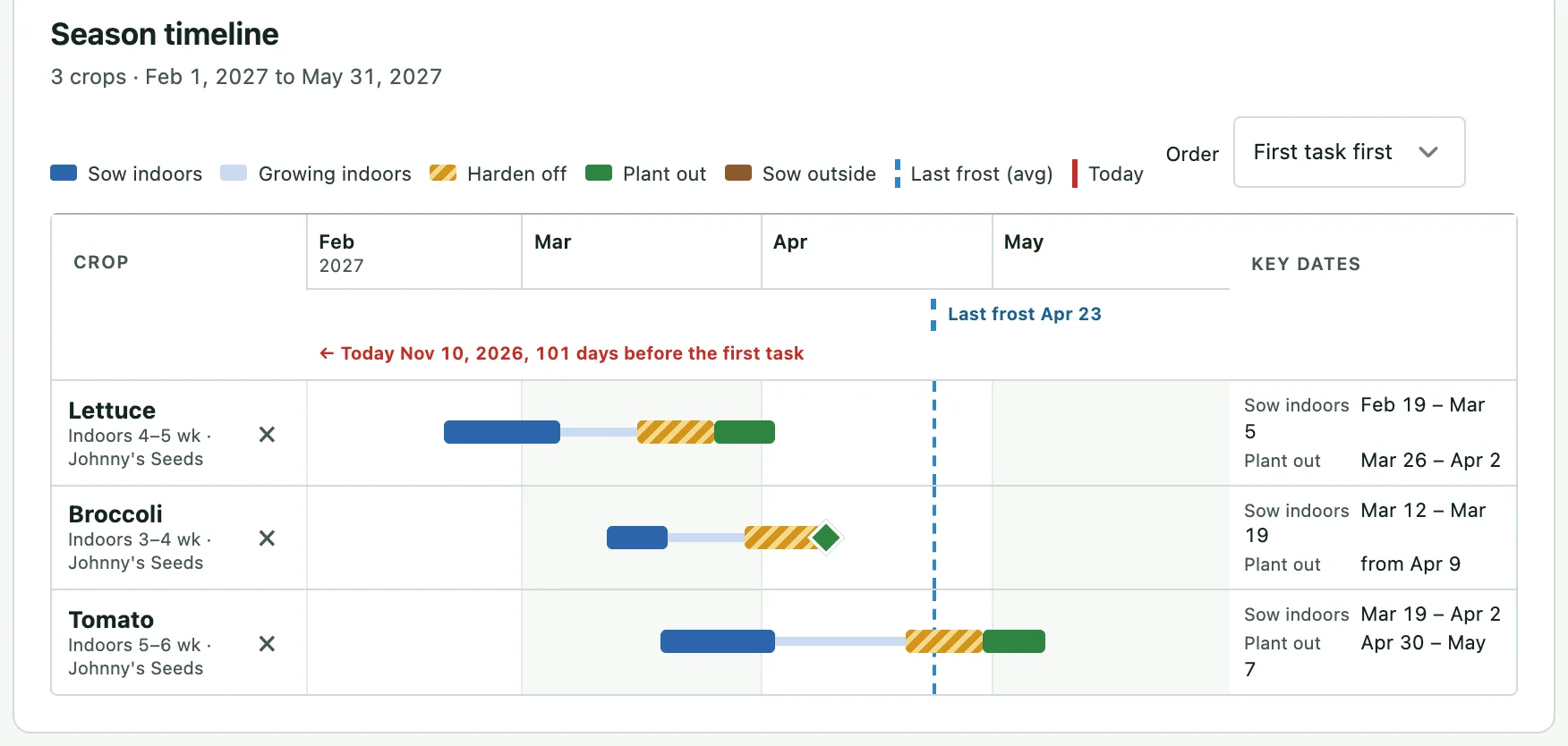
Whether that delay matters depends on your season length and the days to maturity on the seed packet. Neither the calculator nor this report measures harvest.
Which seeds go in which group
WSU, N.C. Extension and Illinois name these seeds. Where they disagree, we list them under every group a source used:
| Group | WSU Skagit County | N.C. Extension, Beaufort County | Illinois Extension |
|---|---|---|---|
| Hardy / winter | Coneflower, columbine, sweet pea, lupine, native grasses, lavender, hollyhock, spinach, kale, thyme, oregano, parsley | Coneflowers, black-eyed Susans, Shasta daisies; sage, thyme, oregano; milkweed, lupine; kale, Swiss chard, lettuce | Frost-tolerant: petunias, cosmos, kale, broccoli, spinach, Brussels sprouts |
| Tender (March–April) | Cosmos, zinnia, marigold, alyssum, lobelia, impatiens, beets, broccoli, basil, cilantro, lettuce | — | — |
| Warm-season | Tomatoes, peppers, eggplant, melons, squash, pumpkins (April) | Avoid tomatoes and peppers | Frost-sensitive: zinnias, tomatoes, squash (March or April) |
Cosmos, broccoli and lettuce each appear in different groups. Illinois counts cosmos and broccoli as frost-tolerant, while WSU puts both with the March–April tender group and warns against sowing cosmos too early. Our rule for these conflicts is to use the later window, unless the seed packet says the seed needs cold stratification. Penn State lists the packet terms that signal a winter-sowing candidate, including “self-sows”, “needs pre-chilling” and “requires stratification”.
What a frost date cannot tell you
- The offset keeps lead time, not coldness. In each translated calendar, the hardy window opens 93 days before the median last freeze, but how cold those 93 days are differs from place to place, and a spring frost date does not measure it.
- A warm spell can start germination too early. Illinois Extension gives this as its reason for waiting until January or February: seedlings that come up in a warm spell may not survive the next cold snap.
- A station is not your garden. Each ZIP uses the nearest NOAA station; elevation and terrain matter, and Seed Window warns when the station is more than 50 km away.
- Hardening off differs by source. Penn State says jug-grown seedlings do not need hardening off. N.C. Extension says to acclimate them gradually if the jugs were kept covered. If you move seedlings out of a closed jug, use the hardening-off schedule.
Reproduce it in Seed Window
- Open the calculator with ZIP 55401. It shows the nearest NOAA station and its 10%, 30%, 50% and 90% last-frost dates. The link only fills the lookup; your saved plan does not change until you pick a date.
- Read the 50% (median) date, April 23, 2027, and add the offsets from Step 1: −93 and −24 days for hardy seed, −23 and +37 for tender, +8 and +37 for warm-season crops.
- To compare jugs with indoor sowing, click the 50% date, keep only Tomato in Choose your crops and switch to Timeline. Use New plan first if you want to keep your own plan unchanged.
- Replace 55401 with your own ZIP. If you garden outside the US, type a frost date from your local source; the offsets work the same way. See why a frost date, not a hardiness zone, drives these dates.
Sources
- Kelly Maupin, WSU Skagit County Extension Master Gardeners, Jump Start Your 2023 Garden with Winter Sowing (PDF, December 2, 2022).
- Angela Mason Foster, N.C. Cooperative Extension, Beaufort County Center, Winter Seed Sowing in Milk Jugs (December 31, 2024).
- Lori Voll-Wallace, Penn State Extension, Starting Seeds in Winter (updated October 3, 2025).
- University of Illinois Extension, Winter seed sowing, quoting horticulture educator Nicole Flowers-Kimmerle (December 6, 2019).
- NOAA NCEI, U.S. Climate Normals 1991–2020: 32°F last-spring and first-fall freeze probabilities, as served by Seed Window’s ZIP lookup.
- Johnny’s Selected Seeds, Seed-Starting Date Calculator (tomato rule).
All sources read on 10 November 2026. Station dates were calculated with Seed Window’s data on the same day.
About this report
Written by the team that builds Seed Window. Station dates come from the NOAA 1991–2020 normals in Seed Window’s ZIP lookup; offsets are date arithmetic on the extension calendars linked beside each claim. Screenshots were taken on 10 November 2026 on the live site. This is a calendar translation, not a germination or yield trial.
Reproduce the examples and inspect the evidenceMake the dates your own
Look up your NOAA frost date by ZIP code, choose only the crops you grow, and check the resulting task windows.
Find your frost date and plan →