Calculate the outdoor planting window first. Then subtract the crop’s indoor growing time from that window. Subtracting every seed packet’s week count directly from the last frost date can start a crop too early.
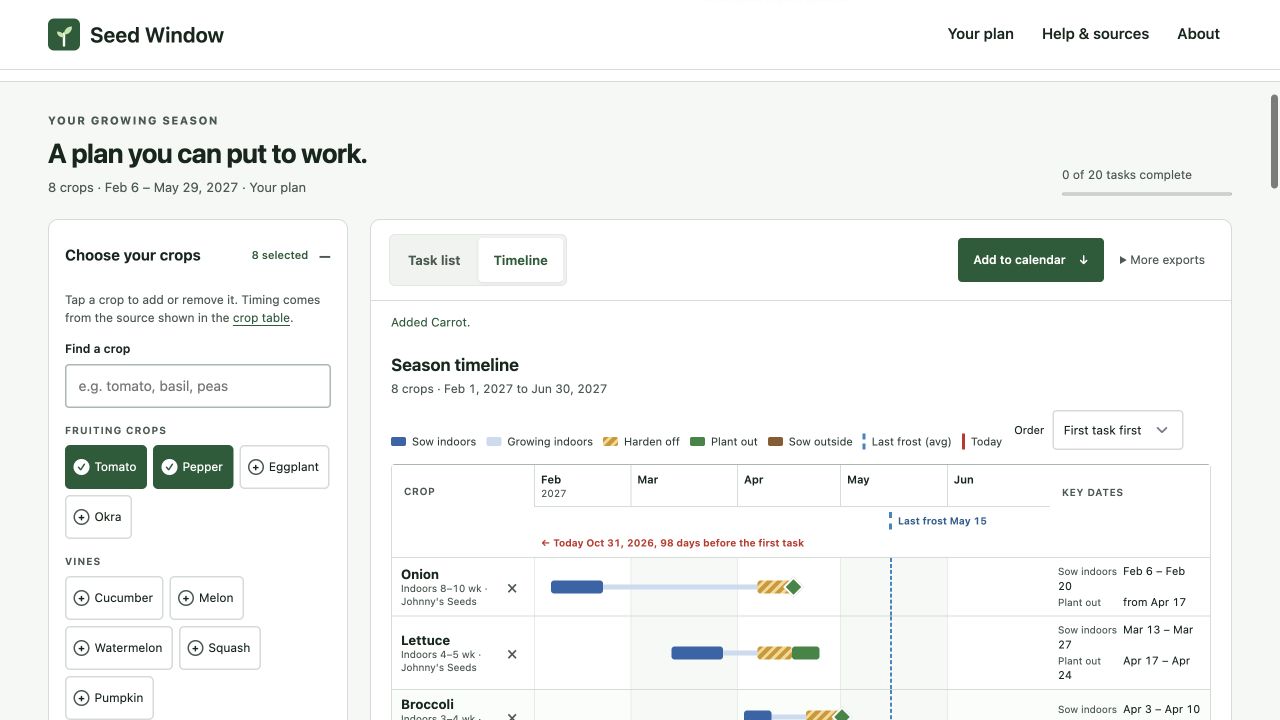
Two clocks, not one countdown
A last spring frost date is an input to a plan. An indoor growing period is measured back from the date the seedling will go outside. Those dates coincide only when the crop’s outdoor offset is zero. In Seed Window, the crop table keeps these two inputs separate: weeks indoors and plant out or sow, relative to frost. Inspect the crop timing table before using a rule for your variety.
For the tomato example, the stored rule is five to six weeks indoors and planting out one to two weeks after the frost-date assumption. The rule comes from Johnny’s seed-starting calculator. It is a planning convention, not an observation from a trial in your garden.
Worked example: May 15, 2027
Earliest sowing = earliest planting − longest indoor period
Latest sowing = latest planting − shortest indoor period
| Step | Calculation | Result |
|---|---|---|
| Earliest planting | May 15 + 7 days | May 22 |
| Latest modelled planting | May 15 + 14 days | May 29 |
| Earliest sowing | May 22 − 42 days | April 10 |
| Latest sowing | May 29 − 35 days | April 24 |
By comparison, subtracting six weeks straight from May 15 gives April 3—seven days earlier than this model’s earliest tomato sowing. That error is arithmetic, independent of whether April 3 could work under a particular grower’s conditions.

Pair the dates when you choose a planting day
The April 10–24 bar is an envelope of possible schedules. It does not mean every sowing date pairs with every planting date. April 10 to May 22 is 42 days; April 24 to May 29 is 35 days. But April 10 to May 29 is 49 days, outside the stored five-to-six-week indoor period.
If May 29 is your actual target, count back from May 29: five to six weeks gives April 17–24. This narrower result is useful when reserving space under lights. Seed Window does not automatically connect a chosen point inside one bar to a chosen point inside the other. Use a custom crop with a fixed two-week outdoor offset to model that target explicitly.
Reproduce it in the workspace
- Open the seed starting calculator. Use New plan to create a separate worked example, then enter May 15, 2027 as the average last spring frost.
- In Choose your crops, select Tomato. Deselect other crops if you want an uncluttered comparison.
- Switch to Timeline for the sowing and outdoor windows; switch to Task list to see hardening off as a separate action.
- Use +1 wk once. Check that all tomato dates move seven days; use −1 wk to restore the example.
What this calculation proves—and what it cannot
We recalculated all 30 built-in crop rules for May 8, May 15 and May 22, 2027. Every populated action-date field moved exactly seven days when the input moved seven days. The complete 90-row calculation dataset makes that result inspectable. It checks the planner’s response to an assumption; it measures neither germination success nor frost survival.
A broad window also says nothing about tray capacity, soil readiness, seedling health or the weather on planting day. For a defensible schedule, first choose and document your frost-date assumption, then keep the sowing and planting dates paired. Finally, reserve time for hardening off before the actual outdoor move.
About this report
Written by the team that builds Seed Window. Numerical examples use the published planner rules and hypothetical inputs. Interface screenshots were captured on 31 October 2026 with synthetic plans; the later Saved plans and backup controls are not shown. These are calculation and workflow checks, not crop-growing or yield trials; no independent horticultural review is claimed. Source links beside the relevant claims let you inspect their scope.
Reproduce the examples and inspect the evidenceMake the dates your own
Look up your NOAA frost date by ZIP code, choose only the crops you grow, and check the resulting task windows.
Find your frost date and plan →