Start onion seeds indoors 8 to 12 weeks before the day you plan to set the transplants out. The set-out day is the real decision. Johnny’s rule sets it 4 weeks before the last frost, which for Minneapolis (median April 23) means sowing January 15–29. University of Minnesota and Nebraska Extension calendars set transplants out in May, which means sowing in February (UMN) or late February to early March (Nebraska). In Georgia, onions are short-day types sown in fall, so a late-winter indoor start is not the usual route.
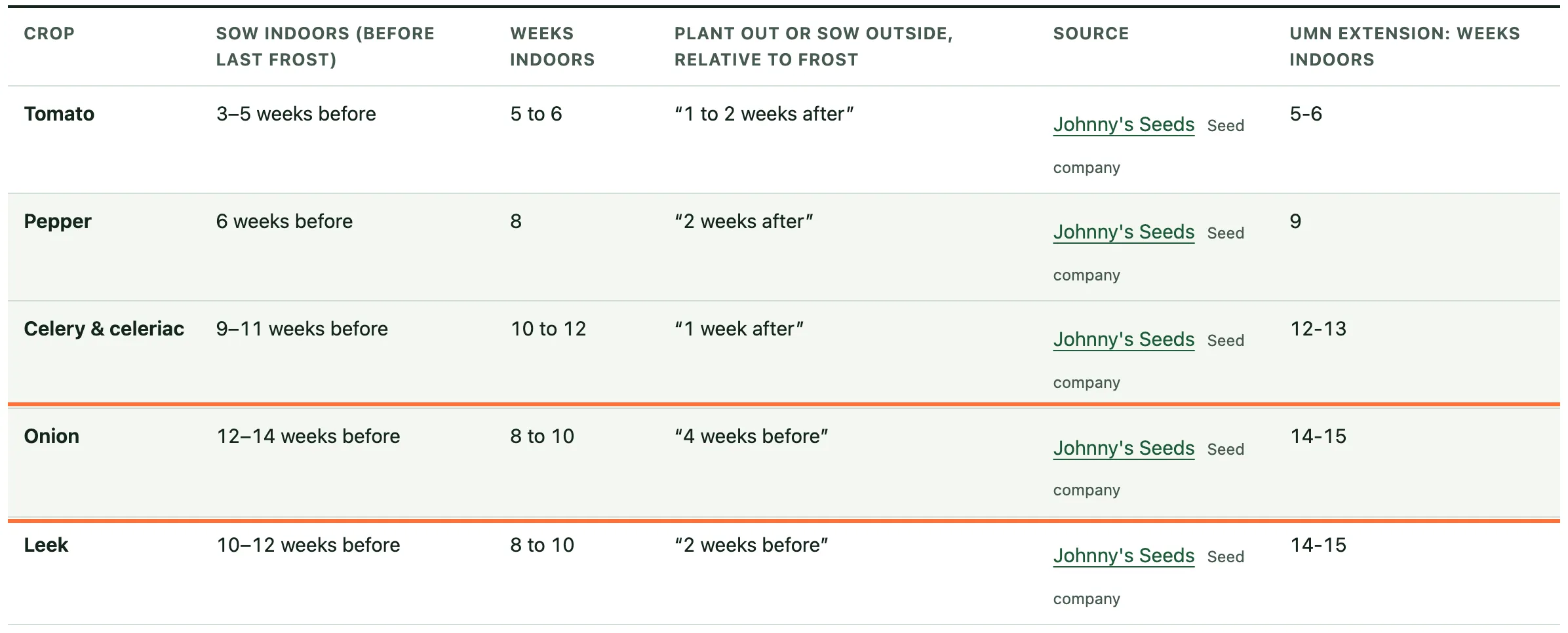
Four onion schedules: 8–12 weeks indoors, different planting-out days
Four sources give a schedule for raising onion transplants from seed. Their onion-specific figures for time indoors range from 8 to 12 weeks. Where they differ is the day the transplants go out.
| Source | Weeks indoors | When to plant out | Calendar given |
|---|---|---|---|
| Johnny’s Seed-Starting Date Calculator | 8 to 10 | “4 weeks before” the frost-free date | None; frost-relative |
| UMN Extension, Growing onions | 10 to 12 | May; transplants “can tolerate light frosts” and go in when temperatures reach 50°F | Start seeds indoors in February |
| UMN Extension, Starting seeds indoors (table) | 14–15 (“how long to keep indoors”) | Harden off all plants in early–mid May | Early February |
| Nebraska Extension, Lancaster County | About 10 to 12 | When soil is dry enough to work and daytime temperatures reach 50°F; transplants tolerate light frosts | Late February or early March, for planting out in early May |
UMN’s seed-starting table is organised by sowing month and ends with “early-mid May: harden off all plants”. Its 14–15 weeks therefore reads as early February to a May planting, not as a separate claim that onions need longer under lights. The direct comparison is UMN’s 10–12 weeks on the onion page against Johnny’s 8–10.
Date both rules for your ZIP
The table applies Johnny’s rule, as stored in Seed Window, to three NOAA medians and puts each region’s extension calendar beside it.
| ZIP and NOAA station | Median last freeze | Johnny’s rule: sow indoors | Johnny’s rule: plant out | Local extension calendar |
|---|---|---|---|---|
| 55401 · LOWER ST ANTHONY FALLS, MN | Apr 23 | Jan 15 – Jan 29 | Mar 26 | UMN: sow in February, transplant in May |
| 68508 · LINCOLN MUNI AP, NE | Apr 24 | Jan 16 – Jan 30 | Mar 27 | Nebraska: sow late February or early March, plant out early May |
| 30303 · ATLANTA FULTON CO AP, GA | Mar 24 | Dec 16 – Dec 30 | Feb 24 | UGA: short-day onions sown in fall; transplants sold in November and December |
As a check, we entered 04/23/2027 in Johnny’s own calculator on 10 November 2026. It returned January 15 – January 29 for starting onions and March 26 for setting them out, the same as Seed Window.
In Minneapolis and Lincoln, the two methods differ by about five weeks. Johnny’s rule plants out on March 26–27; the extension calendars plant out in May, 35 days after March 27 at the earliest (May 1). Because the extension pages also allow more weeks indoors (10–12), the sowing gap is smaller: 3 to 4 weeks (January 15–29 against February 5–26 for the custom crop below). If you sow on Johnny’s January dates and then wait for May conditions, the seedlings spend about 13 to 16 weeks indoors (January 29 to May 1 is 92 days; January 15 to May 7 is 112 days). That is closer to the 14–15 weeks in UMN’s seed-starting table than to the 8–10 weeks in Johnny’s rule.
Choose the planting-out day first, then count back
Nebraska gives a planting cue rather than a fixed date: soil dry enough to work thoroughly and daytime temperatures of 50°F. UMN uses the same 50°F cue, and both pages note that onion transplants tolerate light frosts. Use Johnny’s date as the earliest day you might plant out. If your soil is usually still frozen or wet then, use your own planting-out estimate and count back.
Seed Window can hold both schedules side by side. Add a custom crop with 10–12 weeks indoors, planted out 1 to 2 weeks after the frost date. The “1 to 2 weeks after” is our approximation of “May” and “early May” at these two medians; neither extension page states it as an offset.
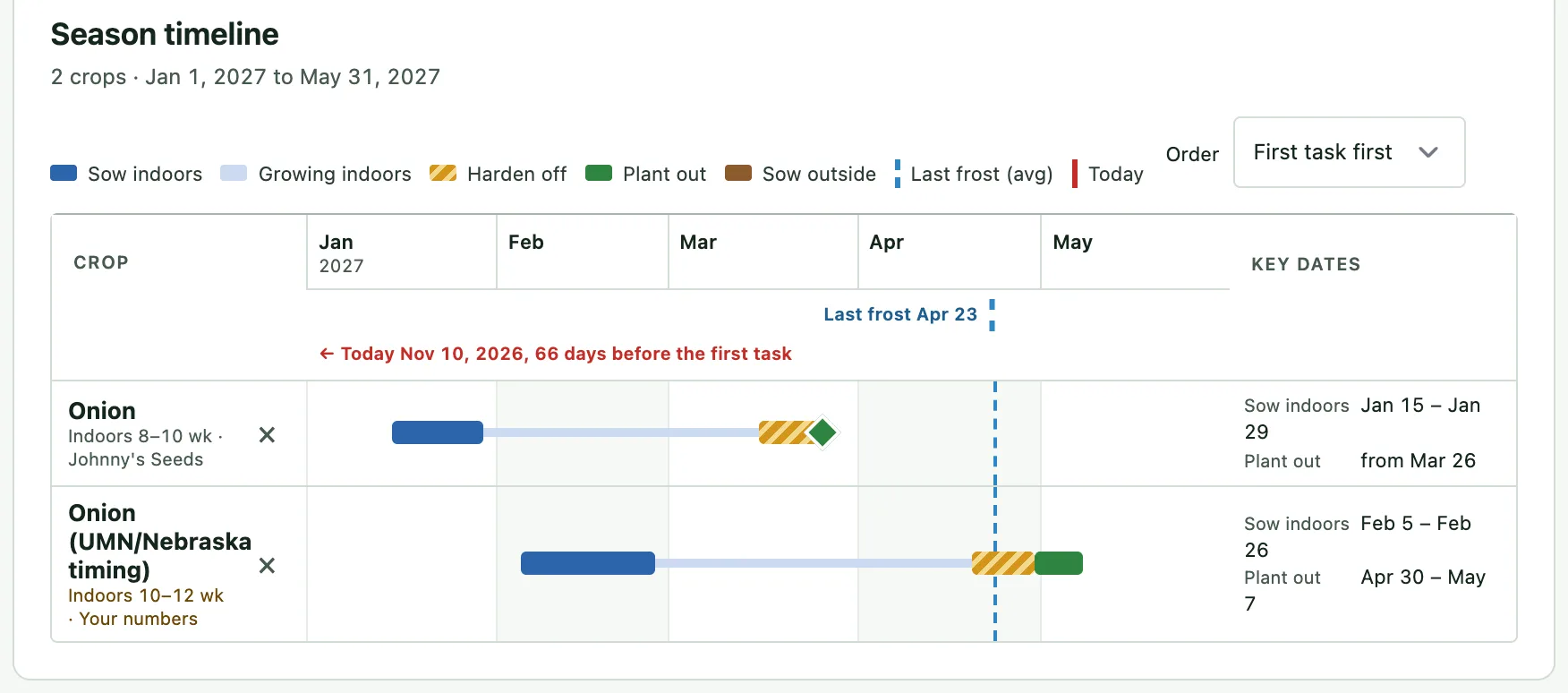
| ZIP | Plant out | Sow indoors | Compared with the source |
|---|---|---|---|
| 55401 Minneapolis | Apr 30 – May 7 | Feb 5 – Feb 26 | Inside UMN’s “February” and “May” |
| 68508 Lincoln | May 1 – May 8 | Feb 6 – Feb 27 | Ends where Nebraska’s “late February or early March” begins |
Earliest sowing = earliest plant-out − 12 weeks (84 days)
Latest sowing = latest plant-out − 10 weeks (70 days)
Day length decides whether a spring schedule applies
A University of Georgia article by horticulturist George Boyhan (2004) groups onions by the day length at which they bulb: short-day at 11–12 hours, intermediate at 13–14, long-day at 15 or more. It says the onions grown in Georgia are short-day types, sown in fall and harvested in spring. Commercial growers sow in late September and reset plants in November and December; home gardeners can direct-seed in mid-October or buy transplants in November and December. Long-day onions are sown in early spring for a fall harvest. UMN describes Minnesota’s storage onions as long-day types that need 14 or more hours of daylight to bulb. The two sources use different thresholds, but both put storage onions in the long-day group.
Seed Window’s December 16–30 date for Atlanta is Johnny’s spring rule applied mechanically. It matches no onion type UGA describes for Georgia: UGA says long-day onions planted there by mistake should be harvested as green onions, and that short-day and intermediate-day onions are sown in fall. In that climate, follow your state extension’s fall calendar rather than a frost-date calculator.
Reproduce it in Seed Window
- Open the calculator with ZIP 55401 and click the 50% date, April 23, 2027. Use New plan first if you want to keep your own plan unchanged.
- In Choose your crops, keep only Onion. The seed chart shows its source and the UMN cross-check column.
- Open Add your own crop or variety. Enter “Onion (extension timing)”, choose transplant, 10 to 12 weeks indoors, plant out between 1 and 2 weeks after the frost date, then Add to plan.
- Switch to Timeline to compare the two bars, then pick one before you export. Export the dates to Google Calendar or print them, and keep the hardening-off days before the planting date.
Sources
- Johnny’s Selected Seeds, Seed-Starting Date Calculator (onion row; calculator run with 04/23/2027).
- Marissa Schuh and Cindy Tong, UMN Extension, Growing onions in home gardens (reviewed 2024).
- UMN Extension, Starting seeds indoors, table “When to plant seeds and how long to keep them indoors” (reviewed 2026).
- Sarah Browning, Nebraska Extension in Lancaster County, Growing Onions: Sets, Plants or Seeds?
- George E. Boyhan, University of Georgia, Choose the right Vidalia onion to sow in garden (August 19, 2004).
- NOAA NCEI, U.S. Climate Normals 1991–2020, as served by Seed Window’s ZIP lookup.
All sources read on 10 November 2026.
About this report
Written by the team that builds Seed Window. Dates come from Seed Window’s stored Johnny’s rule and NOAA 1991–2020 normals; Johnny’s own calculator was run with 04/23/2027 on 10 November 2026 and matched. Extension calendars are quoted from the pages linked beside each claim. Screenshots were taken on 10 November 2026 on the live site. This is calendar arithmetic, not a growing trial.
Reproduce the examples and inspect the evidenceMake the dates your own
Look up your NOAA frost date by ZIP code, choose only the crops you grow, and check the resulting task windows.
Find your frost date and plan →