Start tomato seeds indoors 3 to 5 weeks before your last spring frost date, and peppers 6 weeks before, under Seed Window’s rules from Johnny’s Selected Seeds. For a May 15, 2027 frost date that is April 10–24 for tomatoes and April 3 for peppers. University of Minnesota Extension’s table also keeps tomatoes indoors for 5–6 weeks, but peppers for 9 weeks rather than 8. Check your seed packet for variety-specific timing.
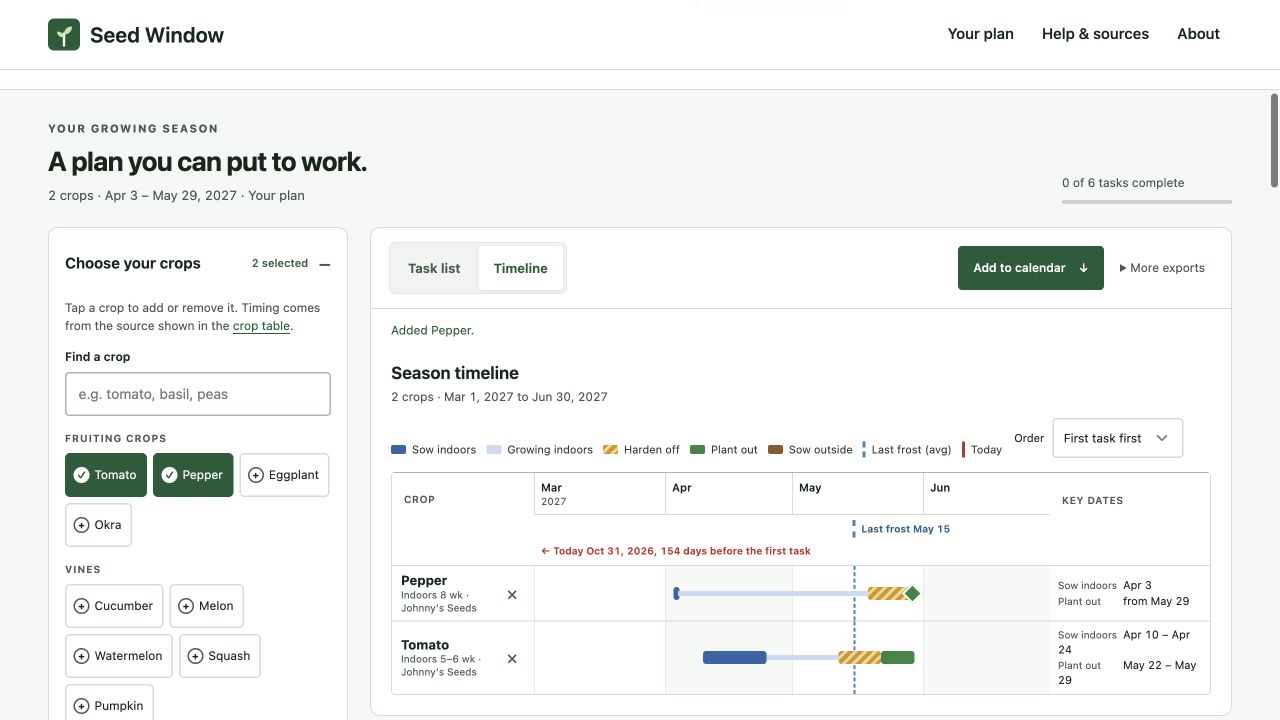
One input produces two different schedules
Putting tomatoes and peppers in one “warm-season vegetables” reminder hides a useful scheduling difference. Seed Window uses an eight-week indoor period for Pepper and a five-to-six-week period for Tomato, following its Johnny’s source rules. It also assigns different outdoor offsets. Compare the complete paths rather than just the sowing day.
| Action | Tomato | Pepper |
|---|---|---|
| Indoor period in the model | 5–6 weeks | 8 weeks |
| Sow indoors | April 10–24 | April 3 |
| Start modelled hardening | May 12 | May 19 |
| Planting-out marker/window | May 22–29 | From May 29 |
The pepper marker is a single earliest date. It is not a deadline that makes May 30 invalid. Likewise, the end of the tomato bar is the end of this modelled window, not proof that a later transplant will fail. The tool does not calculate the remaining growing season or your cultivar’s harvest date.
An earlier start has an indoor-space cost
Suppose you sow both crops on April 3 and plan to move both outside on May 29. The elapsed indoor period is eight weeks for each. That matches the stored pepper period, but exceeds the tomato period by two to three weeks. The calculation identifies an extra period of indoor occupancy; it does not predict a yield penalty.
That distinction matters if seedlings need larger pots before the garden is ready. University of Minnesota Extension’s indoor seed guidance emphasizes planning growing space and following packet instructions. In practical terms, decide whether you can keep an early batch healthy indoors before treating “earlier” as an advantage.
Fix the transplant target before comparing tray dates
For a May 29 tomato transplant, the five-to-six-week countdown narrows to April 17–24. A pepper transplanted on the same day counts back eight weeks to April 3. This is a cleaner comparison than taking the earliest tomato sowing and latest tomato transplant endpoints together. The paired-window calculation explains why.
Use New plan for an isolated comparison or Copy plan before experimenting with an existing garden. In the comparison plan, remove all but Tomato and Pepper from Choose your crops, then use Timeline. Compare the diamond for Pepper with Tomato’s green planting window. Read the dates beside each bar; do not infer a precise date from a small bar’s pixel position.
When the seed packet disagrees
A generic crop preset cannot represent every cultivar or propagation setup. Keep the packet’s indoor duration and outdoor conditions together. Under Add your own crop or variety, enter a descriptive name, choose indoors then plant out, and supply your own week range and before/after-frost offset. That custom row is your assumption, not an additional verified crop rule.
For example, a fixed two-week-after-frost tomato target with five to six weeks indoors produces the May 29/April 17–24 combination above. Label it clearly so it is not confused with the built-in generic Tomato. Do not change the whole garden’s frost date merely to adjust one variety.
Before moving either crop outside
The calendar does not observe your garden. Minnesota Extension’s tomato growing guidance cautions against exposing tomato seedlings to cold conditions and bases outdoor readiness on more than a date. Consult local crop guidance and current conditions before accepting a generated transplant day.
Then work backwards from the chosen day for the hardening schedule. If a cold spell delays planting, look after the plants you already have; moving the planner’s frost input changes planned sowing dates, but cannot move a sowing that already happened. Keep the downloadable 30-crop baseline as a record when comparing revised plans.
About this report
Written by the team that builds Seed Window. Numerical examples use the published planner rules and hypothetical inputs. Interface screenshots were captured on 31 October 2026 with synthetic plans; the later Saved plans and backup controls are not shown. These are calculation and workflow checks, not crop-growing or yield trials; no independent horticultural review is claimed. Source links beside the relevant claims let you inspect their scope.
Reproduce the examples and inspect the evidenceMake the dates your own
Look up your NOAA frost date by ZIP code, choose only the crops you grow, and check the resulting task windows.
Find your frost date and plan →